You’re spending more time fighting your software than using it to grow your business. What started as a quick, cost-effective solution has turned into a daily headache that drains your team’s productivity and hurts your competitive position. Most growing companies stick with off-the-shelf solutions far too long, confusing familiarity with efficiency.
The wrong tools don’t just slow you down. They actively work against you. While competitors build around their actual needs, you’re paying for features you’ll never use while lacking the ones that matter. The good news? Seven clear warning signs tell you when it’s time to make the switch.
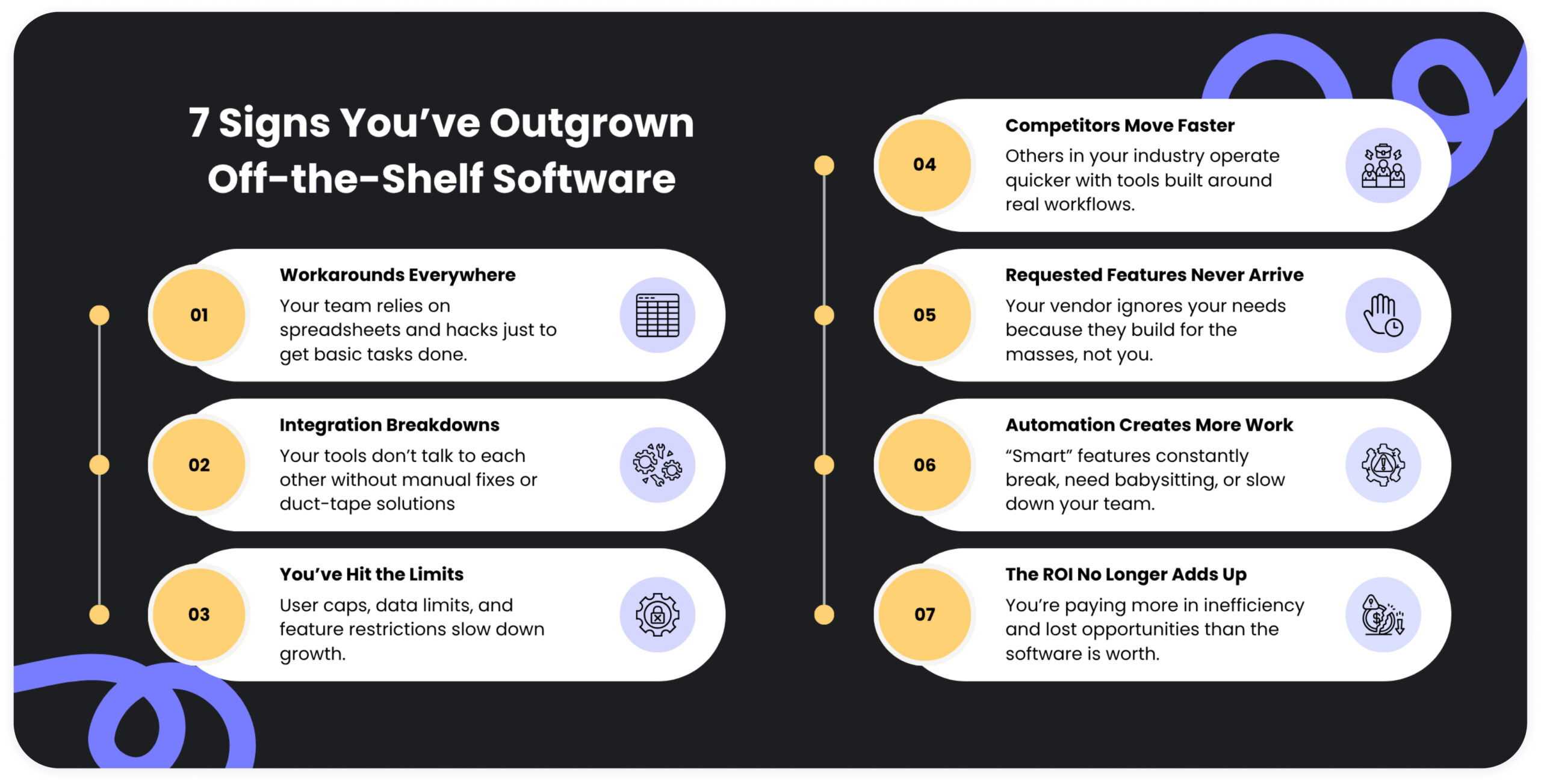
Your Team Has Become “Workaround Warriors”
Your employees have turned into creative problem-solvers, but not in a good way. They’re constantly inventing complicated workarounds to force your current software to handle specific workflows it was never designed to support. Excel spreadsheets keep multiplying to fill the gaps your commercial software can’t address.
This creativity might look resourceful, but it kills productivity and efficiency. Every workaround needs training, creates opportunities for mistakes, and adds unnecessary steps to simple business processes. When your team spends more time figuring out how to use their tools than actually getting work done, you’re paying professional salaries for glorified data entry.
Integration Feels Like Solving a Puzzle in the Dark
Your existing systems look like a patchwork quilt held together with duct tape and prayer. Data moves between tools about as smoothly as rush-hour traffic, requiring manual steps or expensive middleware that creates compatibility issues rather than solving them.
Bad integration wastes time and creates information silos that hurt decision-making. When your customer relationship management data sits in one system, your operations information in another, and analytics in a third, you’re making decisions without the full picture. The cost of these integration headaches often exceeds what you’d pay for a bespoke solution designed to integrate seamlessly from day one.
You Keep Running Into Artificial Walls
Your current software constantly reminds you of its limits. User caps force you to choose which team members get access. Storage limits require constant cleanup. Feature restrictions block workflows you need to run your business operations. You’re always working within someone else’s boundaries, not your specific requirements.
These limits slow growth and force you to make business decisions based on software constraints rather than market opportunities. When you avoid hiring good people because you can’t afford more user licenses, or when you turn down projects because your tools can’t handle complex requirements, your software has become a business problem instead of a competitive advantage.
Your Competitors Are Already Miles Ahead
While you’re wrestling with software limitations, other companies in your space are processing orders in half the time, responding to customer inquiries instantly, and spotting trends you won’t see for weeks. They’re not spending more, they’re spending smarter on tools built for their specific workflows.
The gap isn’t about budget; it’s about fit. Every day your team spends on workarounds is a day competitors gain ground with systems designed around their actual operations. Many growing businesses find that outsourcing software development gives them enterprise-grade capabilities without enterprise overhead.
Feature Requests Disappear Into the Void
You’ve sent dozens of feature requests to your software vendor, each one met with vague promises about “future updates” or suggestions to use existing features in ways that don’t actually work. Your industry needs or unique business processes don’t matter to vendors focused on the mass market appeal of their software products.
This disconnect is more than annoying. Your business model and competitive advantages depend on specific workflows that your current systems can’t support. Every month you wait for new features that may never come is a month your competitors gain ground with solutions built for their actual operations, not what many users might want.
“Automation” Has Become More Work
The automation features you initially loved now need so much setup, ongoing maintenance, and hand-holding that they create more work than doing things manually. Your team spends hours building workflows that break every time the software gets upgrades or your business processes change.
Real automation should reduce manual work and streamline operations, not create different kinds of manual work. When your “smart” commercial solution needs constant attention and your automation rules need weekly bug fixes, you’re trading one time-sink for another instead of gaining the efficiency you need.
The Math No Longer Works
The cost-benefit analysis that justified your current off the shelf software has completely flipped. Between licensing fees for functionality you don’t use, integration costs, productivity losses from workarounds, and missed opportunities from software limitations, you’re paying more to be less efficient than companies with custom solutions.
Smart businesses regularly review their software costs, but many forget to calculate the hidden expenses of inadequate tools. When you add up the time your team wastes on workarounds, the revenue lost to slow processes, and the opportunities missed because of software constraints, that “cheaper option” starts looking pretty expensive compared to a solution designed for your specific needs.
Time to Build the Right Foundation
Staying with software that limits your growth costs more than switching. You’re just paying the price in slower operations, frustrated teams, and missed opportunities instead of upfront investment.
The companies winning in your market aren’t using better off-the-shelf tools. They’ve stopped compromising entirely. Custom software development means your tools finally work the way your business actually operates.
Ready to stop working around your software? Let’s map out exactly what a solution built for your needs would look like, no vague promises, just concrete capabilities that change how you compete.