The question you should ask first: Should you even build custom software now, or is it too early?
Most companies wrestling with this decision are already feeling pain. Your operations team is duct-taping together five different tools. Your sales team complains that the CRM doesn’t match how you actually sell. Your finance team exports data manually every week because nothing talks to anything else.
But pain alone doesn’t justify custom software. Sometimes the answer is to configure your existing tools better. Sometimes you should wait six months. And sometimes building custom software is the right move.
This guide will help you figure out which path makes sense for your business right now.
Your Options (There Are Three, Not Two)
Most discussions frame this as stay on SaaS or build everything custom. That misses the middle ground. You actually have three paths:
Path 1: Stay on Off-the-Shelf Software (But Configure It Better)
This makes sense when your processes roughly match what standard software assumes. You might need better training, tighter configuration, or a consultant to help you use what you already have more effectively.
Choose this path if your business model is relatively standard and your competitive advantage doesn’t come from operational differentiation.
Path 2: Hybrid Approach (SaaS Core + Custom Integrations)
This is the sweet spot for many growing companies. Keep your CRM, accounting software, and other commodity functions on proven platforms. Build custom integrations, automation layers, or specific modules that handle your unique processes.
Choose this path when 70-80% of what you need exists in off-the-shelf tools, but the remaining 20% creates real operational friction or competitive disadvantage.
Path 3: Full Custom Core System
This means building the central nervous system of your operations from scratch. You might still use off-the-shelf tools for peripheral functions, but your core workflow lives in custom software.
Choose this path when your business processes are fundamentally different from standard software assumptions, or when your operational excellence is a key competitive advantage.
How to Tell Your SaaS Stack Is Starting to Crack
Before you can decide whether custom software makes sense, you need to recognize when your current setup is actually breaking down, not just annoying.
Here are the signals that matter:
You spend more time managing tools than using them. If your team spends hours each week exporting data from one system, transforming it in spreadsheets, and importing it elsewhere, you have a problem worth solving.
Critical decisions wait on data you can’t access easily. When executives ask basic questions about the business and it takes days to compile an answer, you have a data integration problem that costs you speed.
Your workarounds have workarounds. One Zapier integration to connect two systems is normal. Seven interconnected automations that break twice a month is a house of cards.
New hires take weeks to understand your “system.” If onboarding requires a 20-page document explaining which tool does what and where the real data lives, your stack has become too complex.
You pay for features you’ll never use while missing features you desperately need. Enterprise SaaS often bundles capabilities. When you’re paying for 80% you don’t need while building spreadsheets for the 20% that’s missing, the economics start to shift.
For a deeper look at these signals, see our full breakdown of the 7 signs you’ve outgrown off-the-shelf software.
Custom Readiness Scorecard
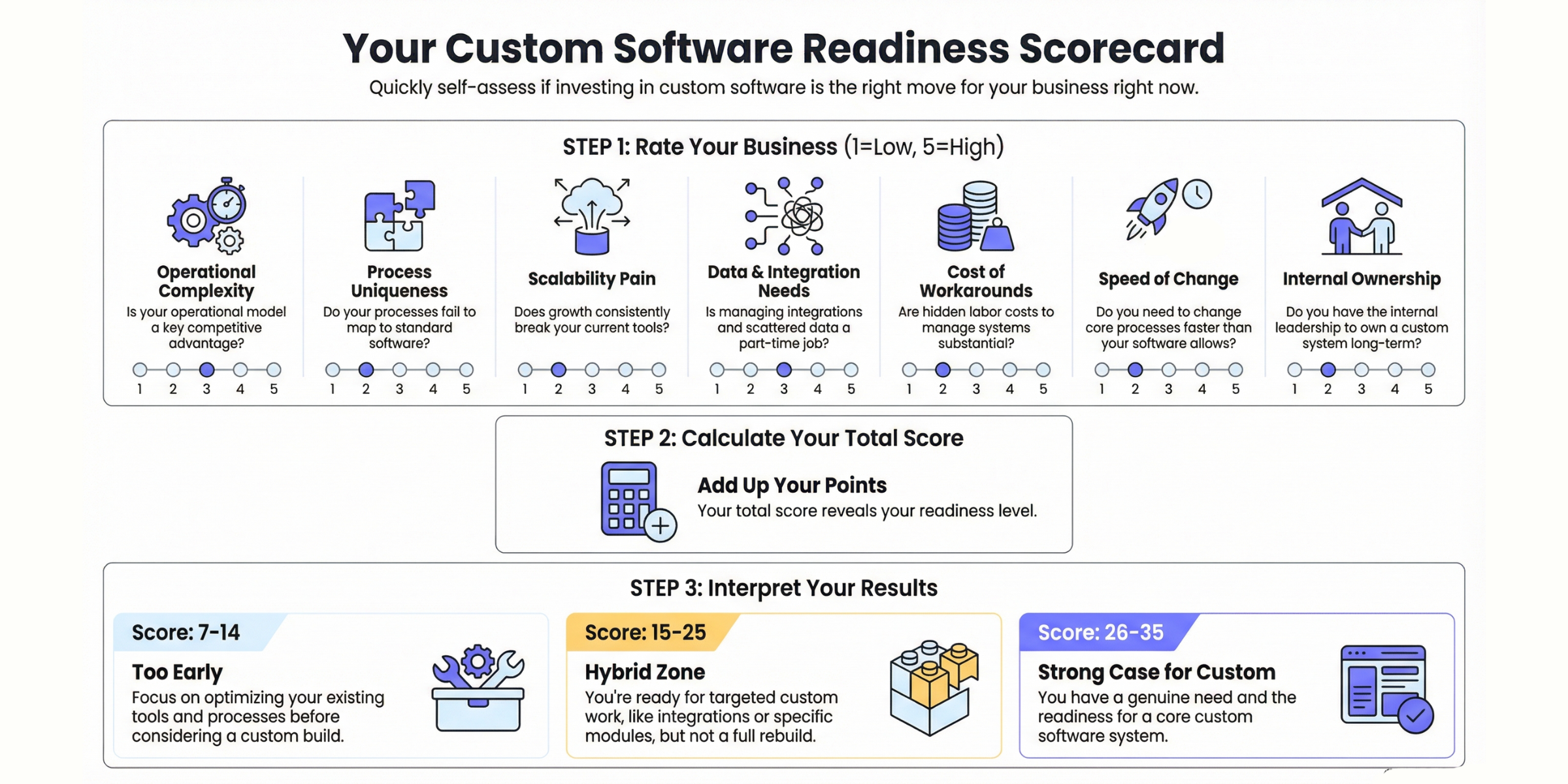
This is where theory meets practice. Score your situation honestly across these seven dimensions. Rate each from 1 (low) to 5 (high):
1. Operational Complexity
1-2: Your processes are straightforward and match industry norms. Most competitors do things the same way.
3: You have some unique processes, but they’re not core to your value proposition.
4-5: Your operational model is a key competitive advantage. How you do things is as important as what you do.
2. Process Uniqueness
1-2: Standard workflows work fine. You sell, deliver, bill, and support customers in conventional ways.
3: You’ve adapted standard processes significantly, but the bones are familiar.
4-5: Your business model requires processes that don’t map to any standard software category. You regularly explain to software vendors that “it doesn’t work like that for us.”
3. Scalability Pain
1-2: Your current tools handle growth fine. Adding users or volume doesn’t break anything.
3: You’re hitting some limits, but they’re manageable with better configuration or a higher plan tier.
4-5: Every time you grow 20-30%, something breaks. You’re constantly hitting artificial limits or facing exponential price increases.
4. Data & Integration Needs
1-2: Your tools talk to each other well enough. Standard integrations handle most needs.
3: You use several middleware tools (Zapier, Make, etc.) but they work reliably.
4-5: You have critical data scattered across systems with no single source of truth. Integration maintenance is a part-time job.
5. Cost of Workarounds
1-2: Minimal manual work. Your team uses software as intended.
3: Some manual steps, but they’re quick and infrequent.
4-5: You have team members whose job is essentially “make the systems work together.” The hidden labor cost is substantial.
6. Speed of Change
1-2: Your business processes are stable. What worked last year works this year.
3: You adapt processes occasionally, and your software keeps up.
4-5: You need to change how you operate every quarter. Waiting for your software vendor’s roadmap means falling behind competitors.
7. Internal Ownership Readiness
1-2: You don’t have technical leadership or product thinking internally. Software is something you buy, not something you build.
3: You have some technical capability but haven’t managed software development before.
4-5: You have (or can hire) someone who can own a custom system. You understand that custom software requires ongoing attention, not just initial development.
How to Interpret Your Score
7-14 points: Too Early
Custom software will create more problems than it solves right now. Focus on configuring your existing tools better, cleaning up your data, or simplifying your processes. Revisit this in 6-12 months.
15-25 points: Hybrid Zone
You’re ready for targeted custom development. Don’t rebuild everything. Build custom integrations, automation layers, or specific modules that handle your unique needs. Keep commodity functions on proven SaaS platforms.
26-35 points: Strong Case for Custom
You have a genuine need and the organizational readiness for custom software. The question now is execution: build with the right partner, scope carefully, and plan for ongoing evolution.
Three Real-Life Scenarios
Theory only gets you so far. Here’s what these decisions look like in practice.
Scenario 1: Too Early for Custom
A professional services firm with 50 employees was frustrated with their project management and time-tracking tools. Projects often ran over budget, and reporting took hours each week. Leadership wanted to build a custom system that “actually fits how we work.”
The Decision: Don’t build. Not yet.
The real problem wasn’t the software. The firm had inconsistent project scoping and weak project management discipline. Building custom software would have automated chaos, not solved it.
Instead, they hired a part-time operations person to standardize their project intake process, trained project managers properly, and configured their existing tools more thoughtfully. Six months later, most of their pain points had disappeared.
The Lesson: Custom software amplifies your processes. If your processes are broken, fix them first.
Scenario 2: Hybrid Approach Makes Sense
A logistics company with 150 employees had grown rapidly by offering same-day delivery with specific handling requirements. Their problem: standard transportation management systems assumed next-day delivery and couldn’t handle their real-time routing needs with specialized constraints.
The Decision: Keep the accounting, CRM, and warehouse management on proven platforms. Build a custom routing and dispatch system that integrated with everything else.
They built one focused system that handled their competitive differentiation (real-time routing with complex constraints). Everything else stayed on SaaS. Total development cost was about 40% of what a full custom solution would have required.
The Lesson: Build custom where you’re truly different. Buy everything else.
Scenario 3: Custom Is Unavoidable
A healthcare operations company managing complex patient workflows across multiple facilities hit a wall. They needed to track patient status, coordinate between specialists, manage compliance documentation, handle billing across different insurance models, and maintain audit trails for regulatory requirements.
No combination of healthcare software could handle their specific model. They’d tried three different platforms over two years. Each time, they spent six months implementing, then discovered fundamental limitations that required extensive workarounds.
The Decision: Build a custom operations platform.
They invested in proper discovery phase work, clearly defined their requirements, and built a system designed specifically for their model. Two years later, their custom platform is a competitive advantage. New competitors can’t easily replicate their operational efficiency.
The Lesson: When your business model is your competitive advantage, and no software supports that model, custom becomes necessary, not optional.
If the Answer Is Yes: What to Do Next
If you’ve determined that custom software makes sense, here’s the high-level roadmap:
Start with discovery, not development. Jumping straight to building is how projects fail. Invest time in mapping your processes, defining requirements clearly, and identifying what you’re actually solving for. A structured discovery phase prevents expensive mistakes later.
Decide on your delivery model early. Will you build an in-house team, work with an agency, or use freelancers? Each model has trade-offs around cost, speed, quality, and long-term maintenance. Understanding your options matters before you commit. Our guide on freelancer vs agency vs in-house development breaks down these considerations.
Plan for evolution, not perfection. Your first version won’t solve everything, and that’s fine. The goal is to build something valuable that you can improve over time. Companies that succeed with custom software think in terms of ongoing product development, not one-time projects.
Find a partner who will tell you no. The best development partners push back on bad ideas, suggest simpler alternatives, and occasionally tell you not to build something. If a company agrees with everything you want to build, walk away.
When Custom Software Is a Bad Idea
Let’s be direct. Custom software is the wrong choice when:
You don’t have a clear business problem. “Our current system is annoying” isn’t a business problem. “We’re losing $50K monthly because our fulfillment process can’t handle same-day orders” is a business problem. If you can’t articulate the specific operational or financial pain, don’t build.
You’re trying to replace process thinking with code. Software can’t fix unclear responsibilities, poor communication, or lack of training. If your processes are chaotic, building custom software just automates chaos faster.
You expect software to magically fix organizational problems. Custom software won’t make siloed departments collaborate. It won’t make your sales team follow up on leads. It won’t make people adopt better habits. Those are management problems, not software problems.
You don’t have an internal owner. Someone in your organization needs to own this system, not just during development, but forever. If you don’t have (or can’t hire) someone with the authority and capability to be the product owner, custom software will drift or stagnate.
You’re in denial about budget and timeline. Custom software costs more and takes longer than you think. If you’re hoping to build an enterprise-grade system for $30K and three months, you’re setting yourself up for failure. Be honest about what you can invest.
You’re chasing trends instead of solving problems. Building custom software because “everyone’s doing AI” or “we should have an app” is vanity, not strategy. Build software when you have a specific problem that matters to your business outcomes.
Making the Decision
The question of when to build custom software doesn’t have a universal answer. It depends on your business model, your operational complexity, your competitive positioning, and your organizational readiness.
What matters is thinking clearly about the decision. Don’t build custom software because it sounds sophisticated. Don’t avoid it because it seems complicated. Make the decision based on honest assessment of where you are and what you actually need.
If you’re in the hybrid zone or genuinely ready for custom software, the next step is talking to someone who will help you think it through, not just sell you development hours.
At SliceIQ, we’ve told companies not to build custom software when it wasn’t right for them. We’ve suggested simpler solutions. We’ve recommended they wait six months and fix their processes first. Because the goal isn’t building software for its own sake. The goal is building the right solution at the right time.
If you want to sanity-check your thinking, talk to us. We’ll tell you honestly whether custom software makes sense for your situation. And if it does, we’ll help you figure out the right way to approach it.